
There is a quiet hesitation that comes with sitting down alone in public. The brief scan for familiar faces. The instinct to check your phone so your hands look occupied. The unspoken fear that being alone might look like being unwanted.
But in a hawker centre, that fear softens almost immediately.
Because eating alone at a hawker centre is not a lonely thing. It is, more often than not, a return to something honest and unforced—a moment where you are allowed to exist without explanation.
A Table for One Is Normal Here
Hawker centres were never built for performance. They were built for people.
Plastic tables are shared. Seats are borrowed. Conversations overlap and fade without ceremony. When you sit alone, no one notices—and that is precisely the comfort. You are not an outlier. You are part of the rhythm.
Office workers eat quickly before returning to meetings. Elderly regulars linger with newspapers and kopi. Students nurse bowls of noodles between classes. Solitude blends seamlessly into the crowd, unnoticed and unjudged.
When You’re Alone, You Notice More
Eating alone sharpens your awareness. Without conversation to fill the space, your attention drifts outward.
You hear the scrape of a wok against metal. You catch the scent of sambal hitting hot oil. You notice how a hawker moves with muscle memory rather than thought, how orders are remembered without notes, how timing is felt rather than measured.
These are small details, but they matter. They remind you that hawker centres are not just places of transaction—they are places of quiet skill and constant motion.
Solitude Is Not the Same as Loneliness

Loneliness asks for something missing. Solitude asks for nothing at all.
Eating alone in a hawker centre often feels like a pause in the day—a moment between responsibilities, errands, or expectations. You are not there to entertain or be entertained. You are there to eat, to rest, to exist for a short while.
And in that simplicity, there is relief.
The Unspoken Comfort of Shared Space
Even when you eat alone, you are surrounded by others doing the same thing in their own way. No introductions are necessary. No eye contact is required. There is a quiet understanding that this space belongs to everyone equally.
You sit, you eat, you leave. And no one asks why.
That freedom is rare.
Why This Matters
In a city that moves quickly and demands constant connection, hawker centres offer something quietly radical: the permission to be alone without being isolated.
They remind us that community doesn’t always mean conversation, and belonging doesn’t always mean togetherness. Sometimes, it simply means having a place where you are allowed to sit down and be yourself.
Come As You Are
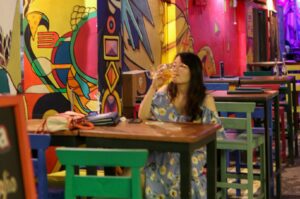
At Singapore Hawkers, we believe these small, personal moments matter just as much as the famous stalls and long queues. Hawker culture is lived not only in groups, but also in silence, observation, and routine.
If you enjoy thoughtful reflections and honest stories from Singapore’s food centres, click here to view our website and explore more drabbles that capture the quieter side of hawker life.
Come alone if you like.
You won’t be lonely here.