
Christmas in Singapore does not arrive with snow or silence. It arrives softly, folded into everyday life. It appears in shopping malls dressed in lights and music, in office pantries filled with snacks, and in group chats trying to coordinate year-end gatherings. But if you want to understand what Christmas really feels like here—not as a spectacle, but as lived experience—you don’t go looking for it in grand celebrations.
You sit down at a hawker centre.
At first glance, there seems to be nothing particularly festive about it. Plastic tables. Familiar smells. The same food you eat every other week. And yet, around December, something shifts. It is subtle, easy to miss if you are rushing. But if you stay a little longer, Christmas reveals itself—not loudly, but honestly.
This is what Christmas feels like at a hawker centre in Singapore.
A Season That Blends Into the Ordinary
Unlike countries where Christmas dominates public life, in Singapore it coexists quietly with everything else. The hawker centre reflects this balance perfectly. There is no expectation for the space to transform completely. No need for themed menus or dramatic decoration. Instead, Christmas arrives layered gently over routine.
You might notice a small strand of tinsel taped to a pillar. A paper Santa taped near a drinks stall. A playlist drifting faintly from someone’s phone while they eat. These details don’t demand attention, but together they signal that the year is coming to a close.
What stands out most is not what changes, but what doesn’t. Hawkers still open at the same hours. Regulars still order the same dishes. The rhythm of daily life continues. And that continuity is comforting.
In many ways, Christmas at a hawker centre mirrors how the season is experienced by many Singaporeans: acknowledged, but not exaggerated; present, but not overpowering.
The Food Doesn’t Change—But the Meaning Does
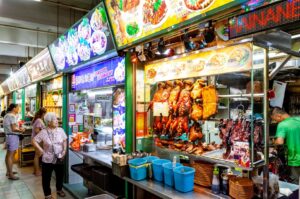
One of the quiet truths about Christmas in Singapore is that we often eat the same food we always do. There is no universal Christmas dish that suddenly replaces everyday meals. Instead, festive feelings are carried by context rather than cuisine.
A bowl of noodles eaten in mid-December feels different from one eaten in July. Not because the recipe has changed, but because the moment has. It might be eaten after the last workday of the year. Or between errands for a modest family gathering. Or during a break from holiday shopping.
At the hawker centre, food becomes a constant against which the season is measured. It grounds the festivities, reminding us that celebration does not always require novelty. Sometimes, it is enough to eat something familiar while the year winds down.
This is one reason hawker centres remain relevant during festive periods. They offer stability at a time when everything else feels slightly louder and more crowded.
Who You See at Christmas Tells a Different Story
The people you notice at a hawker centre in December tell a story of their own.
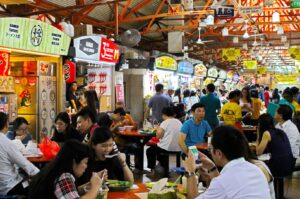
There are office workers eating later than usual, lingering because tomorrow is a half-day or a holiday. Families with children who are out of school, unhurried and relaxed. Elderly diners who treat December like any other month, yet sit a little longer than usual, watching the crowd.
You also see those who may not have big celebrations planned. Individuals eating alone. Small groups sharing simple meals. For them, the hawker centre offers something invaluable during festive seasons: normalcy without judgment.
Christmas can be isolating for some. The hawker centre softens that isolation. It remains open, accessible, and welcoming. No reservations required. No expectations attached.
This quiet inclusivity is one of the reasons hawker centres matter—not just culturally, but emotionally.
Sound, Light, and the End of the Year
If you sit long enough, you begin to notice how the environment shifts toward evening. December sunsets arrive earlier. The light fades faster. Ceiling fans hum steadily as the air cools slightly.
The sounds change too. Lunch-hour urgency is replaced by slower conversations. Cutlery clinks less aggressively. There is laughter, but it is softer, less rushed.
Christmas here is not announced by bells, but by slowing down.
In these moments, the hawker centre becomes a place of reflection. People scroll through photos from the year. They talk about holidays, about plans, about nothing in particular. Plates are cleared, but seats are not immediately vacated.
The hawker centre allows people to linger without pressure—and that, in itself, feels festive.
A Shared Space for Many Beliefs
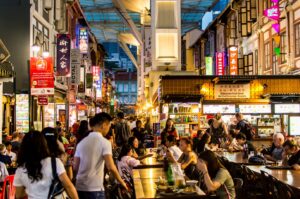
Singapore’s diversity means Christmas is not universally celebrated, yet it is widely felt. At hawker centres, this coexistence is especially visible.
You might see:
- Someone fasting earlier in the day, now breaking their fast
- Another person celebrating Christmas casually, without ceremony
- Someone else treating the day as completely ordinary
All of this happens at the same table cluster, without conflict or contradiction.
Christmas at a hawker centre is not about religious observance. It is about shared time. About being in the same place, even when experiences differ. This quiet coexistence reflects a broader truth about Singapore itself: celebration does not require uniformity.
Why Hawker Centres Hold Festive Weight
It may seem counterintuitive to associate hawker centres with Christmas. They are not traditionally festive spaces. And yet, precisely because of that, they become meaningful during the season.
Hawker centres represent:
- Accessibility during holidays
- Familiar routines in a month of disruption
- Shared space without obligation
They remind us that festivity does not have to be extraordinary to be sincere.
This perspective is part of a larger story about how neighbourhood food spaces function in Singapore. For a broader context, learn more on how hawker centres anchor communities beyond food. Christmas simply adds another layer to that everyday significance.
A Different Kind of Christmas Warmth
Christmas warmth at a hawker centre is not found in decorations or menus. It is found in moments.
A hawker asking if you want the usual.
A shared table that turns into a shared conversation.
A quiet nod exchanged between strangers waiting for food.
These interactions may seem small, but together they form the texture of a Singaporean Christmas—grounded, practical, and quietly kind.
The hawker centre does not try to compete with festive spectacle. It offers something else instead: continuity.
What This Tells Us About Singapore
How a society celebrates says a lot about what it values. Christmas at a hawker centre reveals Singapore’s preference for balance. Celebration without excess. Togetherness without obligation. Tradition without rigidity.
It shows that festivity can exist alongside routine, not in opposition to it.
For many, the hawker centre is where Christmas feels most real—not because it is special, but because it is unchanged.
An Invitation to Notice the Quiet
If you find yourself at a hawker centre this December, try sitting a little longer. Look around. Listen. Observe how the season expresses itself without demanding attention.
Christmas does not always announce its arrival. Sometimes, it simply sits beside you at a plastic table, sharing the same space.
At Singapore Hawkers, we believe these quiet moments are just as important as the big stories. If you’re looking to understand why hawker centres remain at the heart of how Singapore eats and gathers—especially during the holidays, click here to read our article “Hawker Centres: The Heart of Singapore’s Community Dining,” which explores how these everyday spaces bring comfort, familiarity, and quiet joy to festive seasons year after year.